Temple info -3771. Kadambavaneswarar temple, Erumbur,Cuddalore. கடம்பவனேஸ்வரர் கோயில்,எரும்பூர், கடலூர்
Get link
Facebook
X
Pinterest
Email
Other Apps
-
Temple info-3771
கோயில் தகவல்-3771
Kadambavaneswarar Temple, Erumbur, Cuddalore
Kadambavaneswarar Temple is a Hindu Temple dedicated to Lord Shiva located in Erumbur Village in Chidambaram Taluk in Cuddalore District of Tamil Nadu. Presiding Deity is called as Kadambavaneswarar and Mother is called as Kalyana Sundari. The Temple was called as Urumur Siru Tirukkoyil Perumanadigal in ancient times. This Temple was called as Siru Koil as Chidambaram Temple was always referred as Periya Koyil.
Kadambavaneswarar Temple is considered to be the third out of the seven Guru Sthalams in Tamilnadu. It is also believed that those visiting Kadambavaneswarar Erumbur, Virudhachalam and Chidambaram temples on the same day will be blessed with wealth. The Temple was built during end of Pallavas reign and emergence of Cholas as regional power. Hence, the temple follows both Pallava and Chola Architecture and sculptural values.
Legends
Erumbur:
A lady whose reputation was ill spoken asked her son to take her bones to Shiva temples after she dies and wherever they turn flowers, immerse them to prove her chastity. The son after visiting many temples including Chidambaram reached here and while he was bathing, a crow accidently knocked the urn and the bones fell out as flowers. Thus, this place was named Elumbur (Elumbu – Bone in Tamil) which gradually became Erumbur.
Lord Shiva appeared in the dreams of King Aparajita:
The lord is believed to have appeared in the dreams of King Aparajita while he was resting here in the middle of a hard campaign and asked him to build a temple.
Kadambavanam:
Erumbur was called as Kadambavanam in ancient days as the village was located on the banks of Kadambaaru River.
History
Kadambavaneswarar Temple is a Hindu Temple dedicated to Lord Shiva located in Erumbur Village in Chidambaram Taluk in Cuddalore District of Tamil Nadu. Presiding Deity is called as Kadambavaneswarar and Mother is called as Kalyana Sundari. The Temple was called as Urumur Siru Tirukkoyil Perumanadigal in ancient times. This Temple was called as Siru Koil as Chidambaram Temple was always referred as Periya Koyil.
Discover more
Blogging Resources & Services
Hinduism
Places of Worship
Kadambavaneswarar Temple is considered to be the third out of the seven Guru Sthalams in Tamilnadu. It is also believed that those visiting Kadambavaneswarar Erumbur, Virudhachalam and Chidambaram temples on the same day will be blessed with wealth. The Temple was built during end of Pallavas reign and emergence of Cholas as regional power. Hence, the temple follows both Pallava and Chola Architecture and sculptural values.
Legends
Erumbur:
A lady whose reputation was ill spoken asked her son to take her bones to Shiva temples after she dies and wherever they turn flowers, immerse them to prove her chastity. The son after visiting many temples including Chidambaram reached here and while he was bathing, a crow accidently knocked the urn and the bones fell out as flowers. Thus, this place was named Elumbur (Elumbu – Bone in Tamil) which gradually became Erumbur.
Lord Shiva appeared in the dreams of King Aparajita:
The lord is believed to have appeared in the dreams of King Aparajita while he was resting here in the middle of a hard campaign and asked him to build a temple.
Kadambavanam:
Erumbur was called as Kadambavanam in ancient days as the village was located on the banks of Kadambaaru River.
History
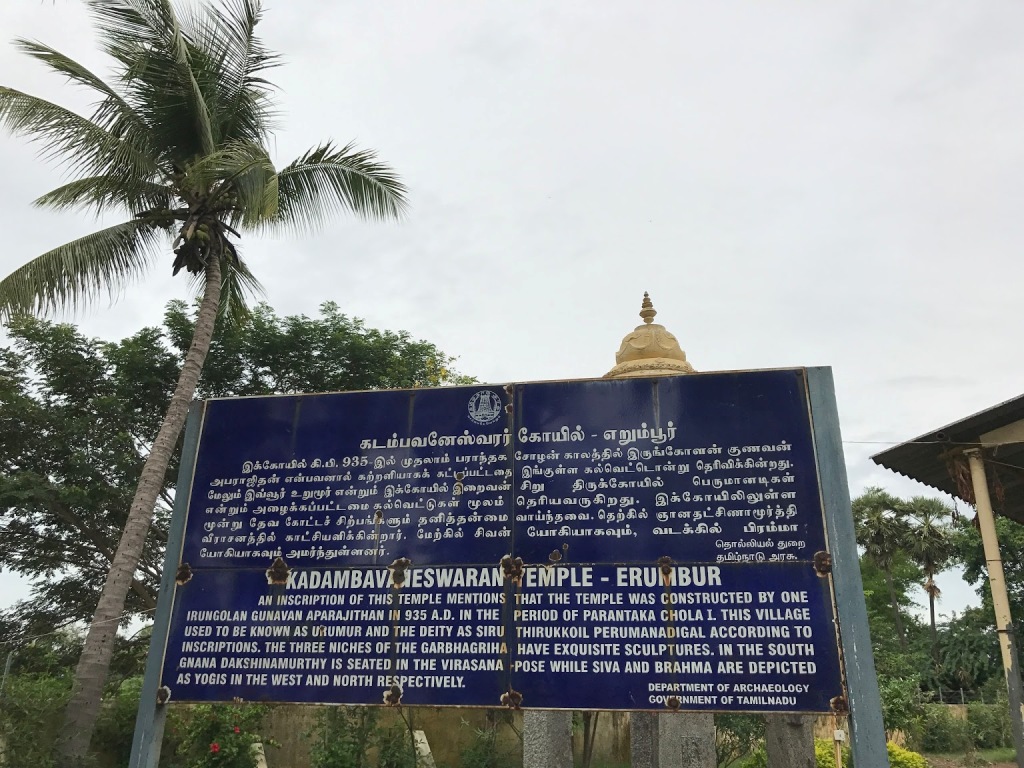
Erumbur, known in the early Chola period as Urumur, is now an insignificant village. The Temple was called as Urumur Siru Tirukkoyil Perumanadigal in ancient times. The presiding deity of the temple is called Perumanadigal of Urumur Siru Tirukkoyil and in later times as Kadambavaneswarar. There is an inscription on the southern wall of the main shrine, on the proper left of the Dakshinamurti image. It is dated in the 28th year of Maduraikonda Parakesari i.e. Parantaka Chola I (935 AD).
It mentions that the vimana (the sanctum with its superstructure) together with the sub-shrines for the Ashta Parivara Devatas (the eight subsidiary deities) round the main shrine, was constructed of stone by one Irungolan Gunavan Aparajitan. The temple is said to have been constructed with the permission of the Chola King, Parantaka Chola I at the request of the donor. It should be mentioned that this inscription relating to the date of construction of the temple of stone is not the earliest inscription found on its walls.
There are few inscriptions belonging to a certain Parakesarivarman and Maduraikonda Parakesari, presumably Parantaka I himself. These refer to a period earlier than the recorded date of the construction of this temple, and they may relate to endowments made earlier. There are many instances of such re-copying and re-inscribing of earlier grants after the completion of the construction or renovation of temples. It is clear that there was ancient mud temple in this village, may be during Parantaka Chola I period, the temple was reconstructed with granite stones. This mud temple might be built by the Later Pallavas.
In 925 A.D, Erumbur was called Nall Vayalur Kootrathu Urumoor, in 1018 AD it was called Vada Karai Rajendra Simha Valanattu Pradhesamana Urumoor, in 1134 AD it was called Vikrama Chola Chathurvethi Mangalamana Urumoor. The name got changed from Vikrama Chola Chathurvedhimangalamana Urumoor of Vadakarai Virutha Raja Payangara Valanadu to Erumbur during Rajaraja Chola II (1153 AD).
There were Thiruvenkatathazhwar Temple, Thirumerkoyil Azhwar Temple and Thiruviramikaramudaiya Periya Nayanar Temple in this village along with Kadambavaneswarar Temple. In addition to these temples, there was a Mandapam called Thiruvarangathevan Mandapam in this Village. There was an inscription in the temple dating to 1026 AD stating that villagers gathered in this Mandapam for annual audits of these temples. Also, Villagers decided to levy local taxes for maintenance of these Temples. This inscription was dated to Rajendra Chola I period. Except Kadambavaneswarar Temple, the Mandapam and the temples were extinct.
There are 20 inscriptions in the temple belonging to Parantaka Chola I, Sundara Chola, Rajaraja Chola I, Rajendra Chola I, Rajendra Chola II, Rajaraja Chola II, Kulothunga Chola II, Vikrama Chola and Thirubhuvana Rajaraja Devan. All these inscriptions talk about grants to burn perpetual lamps, gift of golden articles, local villagers meetings and renovations done to this Temple. People who lived in nearby villages Marungil, Kachipedu, Aanaivaari, Poigai and Ozhukarai also provided gifts to this temple.
The Temple
Kadambavaneswarar Temple is a small east facing temple under the control of the Archaeological Survey of India. The Temple is similar in architectural style to Kanchipuram Chokeesar Temple. As in the case of most Early Chola temples, the central shrine of the original temple belonged to Parantaka Chola I period was made up of only two parts, the sanctum and the Ardhamandapam in front.
The garbhagriha measures 15 ft. 2 in. square in the exterior and 8 ft. 4 in. square in the interior (respectively 4.62 m. and 2.54 m.), and the Ardha Mandapam measures 11 ft. by 7 ft. (3.35 m. by 2.13 m.) outside. The basement has plain mouldings. The present dome-shaped sikhara over the sanctum is a later structure of brick. Perhaps the old sikhara had collapsed and a new partial brick structure was built in its place.
Presiding Deity is called as Kadambavaneswarar and is facing east. He is housed in the sanctum in the form of Shiva Lingam. The walls of the garbhagriha have niches on the three sides of the exterior, and there are stone images of exquisite beauty in them: Dakshinamurti in the south, Yoga Arunachaleswarar in the west and Brahma in the north. These are good specimens of Early Chola sculptures of the days of Parantaka I (10th Century A.D).
The sculptures of Dakshinamurthy in the form of Arthanareeswarar seated on a Trisula without the usual tree above. He is sitting in a different posture called as Veera Asana, with many jewels carved on him. The Dakshinamurthy is a unique form here with dogs, deer and snakes carved in the base. Yoga Arunachaleswarar on Lotus Peedam can be found in the place of Lingothbhava. He is also carved with many jewels on him.
Usually, Brahma will be found in a standing posture in all temples but in this Temple, he is sitting in Lotus Peedam with Akkamalai and Kundhigai. Brahma and Arunachaleswarar in yogic posture are exquisite. It had eight subsidiary shrines round the main shrine in earlier days but there are now no traces of the eight subsidiary shrines.
Discover more
Blogging Resources & Services
Places of Worship
Hinduism
As per early Chola Temple architecture, eight subsidiary shrines are dedicated to Surya, Saptamatrikas, Ganesha, Subrahmanya, Jyeshta Devi, Chandra, Bhairavar and Chandikeswarar. This practice of having eight subsidiary shrines around the main shrine was abandoned due to the adverse preachings of the Tamil saints, the Alvars and the Nayanmars, led to the neglect of the worship of the Saptamatrikas and of Jyeshta Devi.
This feature of subsidiary shrines can be found in the Vijayalaya Cholisvaram at Narthamalai and in many other Early Chola temples, but only here is the inscriptional evidence to prove conclusively that the building of eight shrines round the main Siva shrine to house the subsidiary deities was an important feature of the Early Chola temples. The practice of building eight sub-shrines for the Ashta Parivara Devatas continued even into the days of Rajaraja I.
Discover more
Blogging Resources & Services
Places of Worship
Hinduism
The icons of Nandi and Bhairavar can be found in the mukha mandapa. This is a later structure, 29 ft. by 24½ ft. (8.84 m. by 7.47 m.), with an arch roof in brick and mortar. In the northern projection of this there is a shrine of the Goddess (Amman); the only inscription which refers to this Goddess is that of a Pandyan ruler Maravarman Yira Pandya (1267 A.D), by whose time the Chola power had eclipsed and their country had passed under Pandyan hegemony.
It is very probable that the Amman shrine and the mukha mandapa of brick belong to the 13thCentury A.D. Pandyas named the Mother as Kadambavanaeswara Nayaki but Mother is called as Kalyana Sundari and is facing south. She is in standing posture. There are traces of a brick wall of enclosure with a gate-way in the east, enclosing the main shrine and the subsidiary shrines; and in the foundation, large-sized bricks (measuring 1 ft. 2 in. by 7½ in. by 2¾ in. =35.6 cm. by 19.1 cm. by 7 cm.), can be found belonging to Parantaka Chola I days.
Discover more
Blogging Resources & Services
Hinduism
Places of Worship
Lord Muruga is seen seated on his peacock mount in his shrine in the prakaram. Navagraha Shrine can be found in the western corner of the prakaram. All Navagrahas are gracing the devotees with their consorts and Vahanas (Mounts). There is idol of Veera Narayana Perumal in the Temple premises. Sthala Vriksham is Kadamba Tree. Theertham associated with this Temple is Easwaran Kulam. It is situated to the south east of the temple.
Devotees pray to Dakshinamoorthy here on Thursdays to achieve excellence in Knowledge and also get rid of all obstacles. Thousands of devotees throng this temple during Guru Peyarchi (Jupiter Transition Days).
Connectivity
The Temple is located at about 600 meters from Erumbur Bus Stop, 5 Kms from Sethiyathope, 6 Kms from Sethiyathope Bus Stand, 16 Kms from Vadalur, 17 Kms from Vadalur Railway Station, 22 Kms from Chidambaram, 22 Kms from Neyveli, 24 Kms from Srimushnam, 24 Kms from Virudhachalam, 26 Kms from Chidambaram Railway Station, 28 Kms from Virudhachalam Railway Station, 51 Kms from Cuddalore, 73 Kms from Puducherry, 75 Kms from Puducherry Airport, 202 Kms from Chennai Airport and 223 Kms from Chennai. The Temple is situated towards east of Virudhachalam on the Sethiyathope road.
Devotees pray to Dakshinamoorthy here on Thursdays to achieve excellence in Knowledge and also get rid of all obstacles. Thousands of devotees throng this temple during Guru Peyarchi (Jupiter Transition Days).
Connectivity
The Temple is located at about 600 meters from Erumbur Bus Stop, 5 Kms from Sethiyathope, 6 Kms from Sethiyathope Bus Stand, 16 Kms from Vadalur, 17 Kms from Vadalur Railway Station, 22 Kms from Chidambaram, 22 Kms from Neyveli, 24 Kms from Srimushnam, 24 Kms from Virudhachalam, 26 Kms from Chidambaram Railway Station, 28 Kms from Virudhachalam Railway Station, 51 Kms from Cuddalore, 73 Kms from Puducherry, 75 Kms from Puducherry Airport, 202 Kms from Chennai Airport and 223 Kms from Chennai. The Temple is situated towards east of Virudhachalam on the Sethiyathope road.
கடம்பவணேஸ்வரர் கோயில் - எறும்பூர்
ஊரின் தென்பகுதியில் கிழக்கு நோக்கிய வாயிலுடன் கடம்பவணேஸ்வர் கோயில் அமைந்துள்ளது. கல்வெட்டுகளில் எறும்பூர், உருரூர் என்றே வழங்கப்படுவதால் இவ்வூரே காலப்போக்கில் எறும்பூராகி இருக்கலாம். இச்சிவாலயம் சிறிய கருவறை, அர்த்தமண்டபத்துடன் கற்றளியாக விளங்குகிறது. கல்யாண சுந்தரி அம்மன் என்ற கோயிலும், சிவன் கோயில் முன்மண்டபமும் 13ஆம் நூற்றாண்டளவில் பாண்டியர் காலத்தில் கட்டப்பட்டது.
முதலாம் பராந்தகனின் 28 வது ஆட்சியாண்டில் (கி.பி 935) கோயில் அட்டபரிவாரங்களுடன் கற்றளியாகக்கட்டப்பட்டது. எனவே, முதலில் மண்டளியாக இக்கோயில் இருந்திருக்க வேண்டும். வடகரை நல்வயலூர்க் கூற்றத்து தேவதானம் உறுமுறுச்சிறுத்திருக்கோயில் பெருமான் அடிகளுக்கு இளங்கோவன் குணவன் அபராஜிதன் என்பான் ஸ்ரீ விமானக் கற்றளி மற்றும் பரிவார ஆலயங்கள் எட்டினை எழுப்பியுள்ளான்.
யார் காலத்தில் எப்போது கோயில் கட்டப்பட்டது, என்ற விபரத்துடன் உள்ள கோயில் இதுவாகும். கருவறையைச் சுற்றியுள்ள மூன்று கோட்டங்களில் தட்சிணாரமூர்த்தி, சிவன், பிரம்மா ஸ்தாபிக்கப்பட்டுள்ளனர். தட்சிணாரமூர்த்தி சிற்பம் சையன நியையீல் ஞான தட்சிணாரமூர்த்தியாக உள்ளார். மேற் கோட்டத்தில் அருணாச்சலேஸ்வரர் என்றும் சிவயோகி என்றும் அழைக்கப்படும் சிவன் விமானத்தில் வீற்றிருக்கிறார். சடாமகுடம் புனைந்த நிலையில் சிற்பத்தின் பின் கைகள் மான், மழு ஏந்த, முன் கைகள் யோக நிலையில் உள்ளது. வடக்குக் கோட்டத்தில் நான்முகன் காட்சியளிக்கிறார். தாமரை பீடத்தில் நாற்கரங்களுடன் காட்சியளிக்கும் இவருடைய பின் கரங்கள் அட்சமாலை, கண்டிகை ஏந்துகிறது. புராயதகன் காலச் சிற்பங்களுக்கு எடுத்துளூ hட்டாக இவை விளங்குயீன்றன. இக் கோயிலில் 21 கல்வெட்டகள் உள்ளன.
முதலாம் பராந்தகனுடைய் கல்வெட்டில் இறைவன் சிறுத்திருக்கோயில் பெருமானடிகள் என்று அழைக்கப்பட்டுள்ளார். பெயருக்கு ஏற்ப நிறியக் கோயிலாகவே உள்ளது. கல்வெட்டில் இடம் பெறும் பரிவார ஆலயங்கள் காலவெளளூளத்தில் அழியது விட்டுள்ளன. முதலாம் பராயதகன், சுயதரசோழன், முதலாம் .இராஜராஜன், முதலாம் இராஜேயதிரன் ஆகிய சோழமன்னர்களின் கல்வெட்டுகள் உள்ளன. விசநல்துருவங்கி என்ற பெண் கோயிலில் விளக்கெரிக்க 8 கழஞ்சு பொன்னும் 20 கலம் நெல்லும் அளித்துள்ளாள். கவிசியன் நானூற்றுவன் பொன்னையும், நெல்லையும் பெற்றுக் கொண்டு தினம் உழக்கு நெய் விளக்கெரிக்க அளித்துள்ளார். உறுரூர் சபை சி கொடைகளைப் பெற்றுக் கொண்டு அவைகளைக் கொண்டு கட்டளைகளை நிறைவேற்றி வயதுள்ளது. ஆதித்தன் கண்ணர தேவர் வழங்கிய 90 ஆடுகளைக் கொண்டு சபை உழக்க நெய் வழங்கி கோயிலில் விளக்கேற்றி வயதுள்ளது. ஏழுமா நிலத்தை ஆதித்தன் கண்ணர தேவரிடம் பெற்று நாள்தோறும் திருவமுது படைக்க ஏற்பாடு செய்துள்ளது. கோயிலில் இசைக்கருவிகள்கொண்டு வாசிப்பவர்களுக்கு ஊதியம் வழங்க 5 கழஞ்சு பொன்னை அரையன் விச்சாதிரையன் முதலீடாகச் சபையில் அளித்தள்ளான்.
அமைவிடம் :சென்னையிலிருயது 190 கி.மீ தொலைவில் உள்ளது. சேத்தியா தோப்பு கூட்டு சாலையில் இருந்து விருத்தாசலம் செல்லும் சாலையில் 3 கி.மீ தொலைவில் உள்ளது.
Temple info -1830 கோயில் தகவல் -1830 Perunna Subrahmanya Swami temple is located at Perunna in Changanacherry in Kottayam district, Kerala. The shrine is dedicated to Muruga or Subrahmanya. Thaipooyam in Makaram month (January – February) is one of the most important festivals here. The annual Pallivetta utsavam is held in Vrishchikam month (November – December). Another important festival is the Skanda Sashti. This is perhaps the only Murugan temple in the world in which Muruga is depicted as holding the Vel down. This is because he has just annihilated the demons. In all other temples, Muruga is shown as holding the Vel upwards. The annual Thaipooyam Kavadi procession attracts thousands of devotees to the temple. The 10-day annual festival in Vrischika masam begins on the Kartika nakshatra day. The sankalpam of Muruga in the temple is that of Devasenapathi, who has just annihilated Tharakasuran. Therefore it is believed that Muruga is here in a furious form. The deity faces east...
Temple info -2619 கோயில் தகவல் -2619 UDAYANAPURAM SREE SUBRAHMANYA SWAMY TEMPLE Udayanapuram Sree Subrahmanya Swamy temple is located about 2 kms away from Vaikom Mahadeva Temple on Vaikom - Ernakulam State Highway. This temple was under the direct control of Travancore Kingdom and now under Travancore Devaswom Board. Vaikom Mahadeva Temple and Udayanapuram Sree Subrahmanya Swamy temple are co-related and most of the rituals are same. The temple has 2 Tantris i.e. Mekkad Tantri and Bhadrakali Mattappali Tantri. It is believed that the temple was constructed in encient time for worshipping Godess Kannaki and the name of place was kept as Udayanayakipuram. At the same time, a temple was under construction near Kottayam, for Lord Subrahmanyan, later the godess at her own selected that temple for her, saying this temple is for her and not for Kumaran.Hence name of that p...
Temple info -2583 கோயில் தகவல் -2583 Airavateshwarar Temple, Melamaruthuvakudi , Thanjavur Airavateshwarar Temple is a Hindu Temple dedicated to Lord Shiva located in Melamaruthuvakudi Village near Aduthurai Town in Thiruvidaimarudur Taluk in Thanjavur District of Tamil Nadu. Presiding Deity is called as Airavateshwarar and Mother is called as Abhirami Amman. The Temple is situated on the southern bank of Veera Cholan River. The Temple is considered as Thevara Vaippu Sthalam as Devaram hymns had a mention about this Temple. The temple is considered as Viruchika Rasi Parihara Sthalam. Legends Airavateshwarar: Lord Indra, King of Heaven and his white elephant Airavata were cursed by Sage Durvasa for throwing a garland given to them by Lord Brahma through Sage Durvasa. Indra lost his Kingdom and Airavata turned black. Indra and Airavata worshipped Lord Shiva here and got relieved from the curse. Hence, Lord came to be calle...




Comments
Post a Comment